
Why the Materials You Choose Matter: Reducing the Carbon Footprint of High-Performance Homes
When most people think about a net-zero home, they picture solar panels, heat pumps, airtight construction, and ultra-efficient systems. And while all of those are essential, they only tell half the story.
If a building is constructed with high-carbon, high-GWP (global warming potential) materials, the environmental impact begins long before anyone turns on the HVAC system.
In other words:
Your building materials impact the overall “efficiency goals” of your project.
It’s a bit like saying you’re starting a diet… but binging beforehand. It doesn’t make sense.
At the Yeti Cooler House, we set out to build a home that performs at the highest level without taking on a massive embodied-carbon “debt.” Here’s how we approached that goal—and what homeowners, builders, and designers should know when selecting materials.
What Is Embodied Carbon?
Embodied carbon refers to the emissions associated with the extraction, manufacturing, transportation, and installation of building materials. Some products—especially those with high-GWP blowing agents—create a surprisingly large climate impact before they ever reach the jobsite.
Choosing materials with lower embodied carbon:
- Reduces your home’s total carbon footprint
- Supports long-term climate goals
- Often improves indoor air quality and durability
- Aligns with net-zero, Passive House, and high-performance design principles
Why We Chose a Spray-Foam-Free Build
Spray foam is widely used, but it comes with serious tradeoffs. The blowing agents found in many spray foam products can carry a GWP of over 1,000—meaning they trap over 1,000 times more heat in the atmosphere than CO₂. XPS rigid foam is even higher, often around 1,400 GWP.
These numbers are staggering in a home where we’re trying to reduce impact, not add to it.
So at the Yeti Cooler House, we went spray-foam free (except for a tiny patch at a rim joist where we missed an air barrier detail).
Instead, we used:
- Recycled EPS rigid foam reclaimed from a local hospital project
- Cellulose insulation, which has zero blowing agents
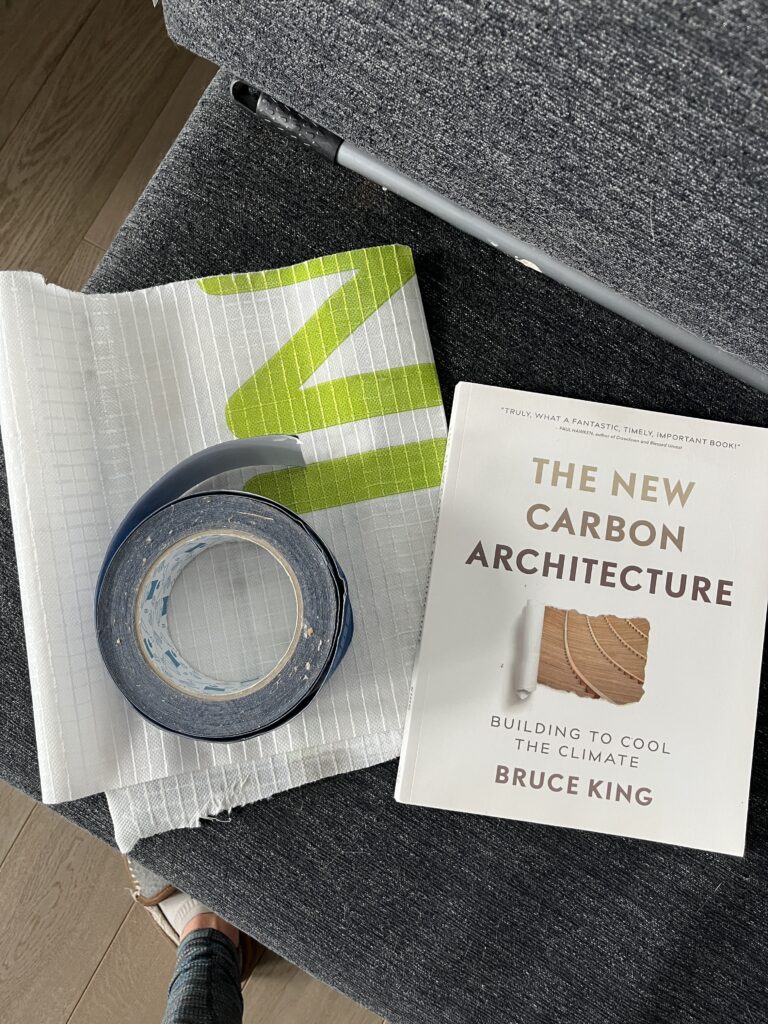
- A hybrid air-barrier system using Intello Plus and Vana tape
This combination creates a flexible, durable, airtight enclosure—without the embodied-carbon cost.
Why Flexibility Matters in Air-Barriers
Spray foam may seem rigid and effective at first, but buildings naturally move and expand. Over time, rigid foams can crack, compromising airtightness and performance.
Products like Intello Plus and Vana tape move with the structure. That keeps the enclosure tight over the long term, ensuring:
- Better building durability
- Lower operational energy use
- Fewer air-quality issues from cracks or gaps
It’s a win for both performance and sustainability.
Comparing the Global Warming Potential (GWP) of Common Materials
Here’s a simplified snapshot of the blowing-agent impact mentioned in the video:
| Material | GWP (Approximate) | Notes |
|---|---|---|
| Closed-cell spray foam | ~1030 | Highest due to HFC blowing agents |
| XPS rigid foam | ~1430 | One of the highest GWP materials in residential construction |
| EPS | ~7 | Much lower; recycled EPS is even better |
| Cellulose | 0 | No blowing agents; often carbon-negative |
When you multiply these numbers across an entire building envelope, the impact becomes enormous.
Other Factors to Consider When Choosing Low-Carbon Materials
Beyond GWP, think about:
- Transportation distance (local or reclaimed > imported)
- Off-gassing and indoor air quality
- Lifecycle durability
- Recycled content or recyclability
- Material flexibility and long-term airtightness
These small decisions create big impacts—both for the home and the planet.
Our Goal: A More Carbon-Negative Building Strategy
For the Yeti Cooler House, the goal wasn’t just “net-zero energy.” It was to make the materials themselves as carbon-negative as possible within the air-barrier and insulation package.
We believe this approach is essential for the next generation of high-performance homes—especially as the building industry shifts toward low-carbon design and more climate-conscious construction practices.
If you’re designing, building, or remodeling, take the time to explore the embodied carbon of your material choices. It’s one of the most impactful decisions you can make.
Want help designing a low-carbon, high-performance home?
At Full Circle Construction Services, we support:
- HERS ratings & energy modeling
- Airtightness and duct-leakage testing
- Material consulting for embodied-carbon reduction
- Net-zero and high-performance design strategies
- Aeroseal duct sealing
- Manual J/S/D calculations
- Building science consulting
Sealed Tight. Tested Right.
🔗 www.fullcircleconstruction.services
🔗 www.yeticoolerhouse.com